

Archives for the month of: October, 2015

iStock_000025083967_Large

1. Set up a routine for your students
All students but especially those with special needs have their learning experience enhanced by a routine that gives them confidence. It gives a structure and minimizes discipline problems for children of different learning abilties.

2. Have your students involved in classroom decoration
This is a fun way to get everyone involved in their learning environment, and can be split up in several arts, crafts and writing activities. A classroom is never too much decorated.
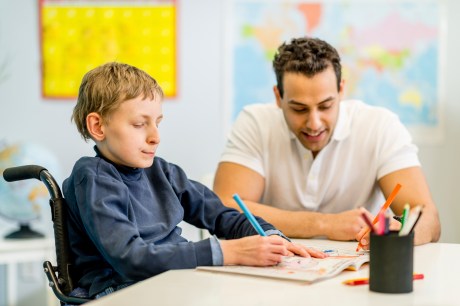
Boy with Developmental Disability

3. Be patient
You will not master special education in a day. Be patient with yourself, and with your students. Each year, things will get better over time as you know them better and find what works for you all.

4. Be organized
You will soon discover that as soon as you think you are done with paperwork, there is more to do. Keep up with it in a timely manner or you will be fast buried unto it.

5. Be dynamic
You will spend time looking for your path and then suddenly, something will change. A new student may be added to your classroom, there may be changes in the school staff, or your students start to behave differently. Do not take any of this personally and move on to find the next best solution!

iStock_000017867607_Large

6. Adapt testing to your students
Not all children need to be tested the same way. Unlike mainstream classrooms, yours is special because you have the opportunity to make these students feel bright. For instance, the test can be in writing for some, in speaking for others.

7. Communicate with parents
They will love getting news from the classroom, but they will also provide you with amazingly helpful information on your students. They’ve probably figured out a few things on their child before you and what they haven’t figured out, you can share with them. Communication is the key.

These are Colored pencils on white

8. Do your research before buying supplies
Some school supplies out there are not truly adapted to special needs kids. Check that they are safe, easy to use and frustration free before making your purchase.

9. Find someone you can speak to
They don’t have to be in your field. It can be a friend, your spouse or whoever you are comfortable with! It’s always good to have a fresh set of eyes on your everyday problems or even just be able to vent.

10. Talk with other special ed teachers
They will always have interesting tips that worked in their classroom. It can be overwhelming if you try to make them all happen at once, but do take pieces of advice here and there based on your own classroom style.

11. Be proud of what you do
Because, you can! Remember those days when becoming a special ed teacher was just an idea and see all you have done. You do one of the most beautiful jobs in the world. Believe us, many parents out there are jealous of the time you spend with their little ones. They would take your seat, if only they could.

keep-calm-and-teach-on

12. Finally, relax!
You ARE a superhero (all teachers are). But even superheroes take breaks. Remind yourself that not everything can be perfect and as long as you have the right attitude, it will all work out.

October is Down Syndrome Awareness Month, a time when folks around the country hold fundraisers and raise awareness for the genetic disorder that affects approximately 400,000 in America and four million people around the world.

In 1995, the National Down Syndrome Society (NDSS) introduced Buddy Walks, the world’s most widely recognized public awareness program for the Down syndrome community. Beginning with 17 walks around the nation its inaugural year, Buddy Walks has expanded to over 250 global walks a year, raising $13 million in 2013 alone. So how do events like Buddy Walks help the cause?

1. DSAM widens Familiarity

DSAM helps familiarize the masses about the disorder. Even basic facts about the causes of Down syndrome (Down syndrome occurs when an individual has a full or partial extra copy of chromosome 21) are widely unknown. Many also don’t realize how common it is, when in reality Down syndrome is the most common chromosomal condition.

Spreading awareness also means enlightening the public on the characteristics of Down syndrome —many may not realize that while children with Down syndrome may have had their development altered, they can still grow up to be intelligent, independent adults with their own opinions and wonderful personalities.

Leading not only to understanding, awareness also helps fight against discrimination. Awareness also leads to funding, which betters the research, which can better medical treatment and eventually help the cost of treatment to decrease.

2. DSAM Funds Research

Although much research has been done, there remains a ways to go in Down syndrome research. For example, learning more about the intellectual disability can help a Down syndrome baby from the outset to develop into the healthiest person possible with improved learning and memory skills. Research-fueled solutions can also mean a decrease in healthcare costs.

3. Research Leads to Medical Progress

Babies with Down syndrome are immediately expensive. Medical treatment for a child with Down syndrome is 12 to 13 times more expensive than that of a child without Down syndrome. Higher costs can ensue when a congenital heart defect is also a factor or if the person develops Alzheimer’s — a common issue when people with Down syndrome are in their 50s and 60s. The good news is that strides in medical research has helped tremendously, and has actually doubled the lifespan of a Down syndrome person.

4. DSAM’s Mission is to Eliminate Discrimination

Misinformation leads to discrimination, which is why organizations like NDSS celebrates Down Syndrome Awareness Month. The Society specifically says on its website, “The mission of the National Down Syndrome Society is to be the national advocate for the value, acceptance and inclusion of people with Down syndrome.”

There’s still work to be done, but awareness increases understanding. It’s important that more people comprehend that despite challenges, children with Down syndrome can grow to be stable, successful, and happy individuals with empathy and compassion, who go to college, work, vote, marry, and volunteer. Awareness of what the everyday lives of people with Down syndrome entails can only lead to progress and equality.

To find a Buddy Walk near you, go to the National Down Syndrome Society here, or you can find other ways to give here