
Archives for posts with tag: sensory diet

I could see it starting….

Those of you who have children with sensory issues know what I am talking about.

The start of an overload.

A sensory overload.

For us now, it is usually caused by too much going on with our schedules or emotions about some day to day things that Elizabeth has not talked about.  Back when Elizabeth was little, the overloads or shutdowns could be triggered by as little a thing as putting on shoes or having someone talk to her in public.

But now, it is the above.

So, she started saying she was not hungry.  And for Elizabeth that is huge. It is like saying that “Today I am not going to use oxygen”  That is how significant that comment is.

Then she started humming a bit.  NEVER a good thing.  She does this to calm herself.

Then she started having trouble organizing herself and her system enough to do the simplest of tasks.  I asked her to get something off of the pantry shelf.  It was right in front of her and she was unable to locate it.   

Yes, it was starting alright.

On this journey with Elizabeth, we have learned how important it is to talk, share, express feelings and to teach Elizabeth how to advocate for herself.   

We talk often and long, she and I.

But usually this has to wait until her system is calm again. But the self advocacy is the part that she has been taught to use to help us help her.  It begins by her saying “ Mom, I am overwhelmed, I need a break.” Or “ I need time alone.”  

So our hard work paid off and she said one of the above phrases.

So now came the time to talk about what sensory items she needed to help her.

She picked her “big heavy blanket”,  It is like a weighted blanket but is actually a heavy comforter. And her vibrating pillow.  Whose name is Senseez.

She uses both of these, along with dim light and vanilla wax melts ( plug in ones, NOT flame)….this combination.

This vibrating pillow is something she loves very much.  She says it makes her feel “calm” This pillow has a nice soft vibration to it.  Typically this pillow is used when she is overloaded.

She will pick it when she is nervous or scared.  
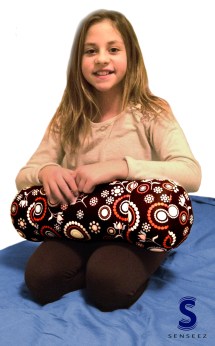
Usually she leans on it to activate the gentle vibration   But you can sit on it or hug it as well.

Elizabeth uses the pillow at home during this quiet time, but it can be used at school or at bedtime and for reasons other than the ones we use it for.

About 45 minutes later, Elizabeth came downstairs.  “ I feel relaxed Mom.”  And she looked like it too.  There was a nice calmness to her.

So we took the time later that day to talk about what led to the need for the break.

She had so many things she was thinking about.  Pretty deep things.  Like “Do you think Popi likes heaven because I miss him?”  Popi is my beloved Dad, who passed away almost three years ago. And there were more thoughts and feelings as well.

So we talked and talked and I hugged her when she cried.  I love this amazing child so much.

I am not saying that dealing with shutdowns or meltdowns is ever easy, because it never is.  But as special needs parents,  knowing your child needs and HOW to help them get those needs met, via a sensory diet, is critical to help them navigate this thing called life.

Please take a look at Senseez, a sensory product, and decide if you think it would help your sensory child or ask you OT for their help.  And as always, I would love to hear your thoughts and the successes you are having on your journey.

I wish you a peaceful week.
Michele

When someone asks me what I remember most about our early times with Elizabeth, the time before we knew what disorders she had.  My mind’s eye takes me to the memories of her crying.  

Simply crying, most, if not all of each and every day.

Crying on and on.

So flash forward to the time after we received the diagnosis of her disorders Sensory Processing Disorder (SPD).  Sidebar here..it was called Sensory Defensiveness at the time. And Global Dyspraxia.  They are co-morbid disorders.  Meaning if you have one you will most likely show signs of the other.  

So we had the diagnosis.  Then we met with our Occupational Therapist who talked to us about this small little brush, how to use it and a little thing called a sensory diet.  Truth be told we weren’t ready yet.  So that little brush did not enter our world until we met Mary.

Mary, our beloved therapist Mary, who is still on our “team” gave us the brush, a plan for how to use it and a hug.   She told us the brush was the Wilbarger brush and the way to use it called the Wilbarger Protocol. She told us this was the beginning of the sensory diet that Elizabeth was going to need to help her body be “organized” and that organization would help her start to make gains in many areas. It was a special brush, I was told.  Not any old one will do. The same brush is available on our website, under Wilbarger brush.  

I remember looking at this brush, turning to look at my Elizabeth and thinking, “I cannot believe that this small object will really be able to do all the Mary says.”

Wilbarger Therapressure Massage Brush Balta Brush specialneedsessentials

The Wilbarger Brush

I can remember being told how to use it, when to use it, what to watch for, what to hope for and what to hope does not happen.  I was told so much and I wrote it all down.  I took that little brush home, along with a near ream of papers about it.

And we began the protocol and I began to write down when we used it.  We used it every two hours as I was told to, every day, for over 2 years. That was our time frame, everyone’s will be different.

We brushed arms first, then down to the legs.  NEVER the stomach or chest.

Elizabeth did not like it at first, but after a bit, she would bring me the brush if she needed it or if I was a bit late using it.

We saw changes…small at first.  Like “Hey, she’s not crying,” to big ones like, “Hey, she is trying to color.”   Please remember, EVERYTHING was offensive to Elizabeth.  She had severe SPD.  So touching a crayon was quite a momentous thing.

We kept in close communication with Mary because this is an important thing to do when you are doing this program.  It is not something one can just start.  According to the website www.ot-innovations.com   “Training is an absolute necessity before attempting to use this technique in practice.  Use requires a trained therapist otherwise harmful or ineffective influences may be the result.”  

So the positive growth kept coming and we saw smiles not tears and we saw her being so much calmer during the day. According to the same website, the positive growth can include “An increase in ability to transition to new things, increase in attention span, decrease fear and discomfort being touched and an increased ability of the central nervous system to use information that is coming in.”  

What all that means is the sensory information that was so offensive to Elizabeth’s system will now be so much less. Hugging does not feel like it hurts, transitioning from one activity to the next without a meltdown, and she can focus longer to learn instead of always being on hyper-alert.

We saw the growth and successes in all these areas, and that little brush became quite a valuable commodity to us.  I remember buying an extra one from Mary because it is important that the bristles are not bent for it to work its best to provide specific stimulation to the nerve endings of the skin.  Please remember, we started our journey in 1997 and the internet was not what it is today. Therefore, buying more brushes or any supplies, really, for Elizabeth was work. I was always so careful to know exactly where the brushes were located at all times. 

Thank you little brush and big protocol for what part you played in finding Elizabeth inside of the crying little child.  

I offer to those wondering about the brush and the protocol to talk with an occupational therapist to see if the brushing will help your child.  If the answer is yes, please order on our site and start.  In my opinion and in our world, it was life saving, or rather life finding.

I wish you all a peaceful week and as always any and all responses are welcome.

Michele


**Author note** the protocol includes joint compressions as well as brushing.  Joint compressions need to be demonstrated and practiced in person to be safe and effective.  The author chose not to mention them in the article but please ask your occupational therapist about them as well.