
Archives for posts with tag: Children

How many times a day do you look at your watch or the clock on your phone?  If you are like me, then you probably do it many times.

We have the concept of time.

We understand that we must manage time to function well in life
.

For example: We know how long it takes to get somewhere, how long it takes to get ready and we can figure out, based on the above, how soon we need to leave to arrive at an appointment on time.

But so many of our special needs children do not grasp the

They do not fully understand a half hour versus 45 minutes.

Or that you need to do something for 25 minutes then get ready to leave.

I know Elizabeth and I have had many talks about time.  But for those who have the same disorders that she does, Dyspraxia and Sensory Processing Disorder, time is simply not grasped or fully understood.  By this I mean, Elizabeth knows how to manage a schedule, she knows what she is doing each day.  She even remembers dates and events for me, which trust me, makes her smile because I “lost my focus” as she says.  But if I ask her how long she was volunteering, I may receive the answer of “about 20 minutes”…and she was there for 2 hours.

So, recognizing the needs of our special needs children is critical.  Putting supports into place to help them is critical. Teaching and reinforcing concepts of time is critical.

But how to do this?   

I started with a timer.  I started by telling Elizabeth what we were doing and for how long. I started by telling her what we would do next once the timer went off.  And we used the timer for managing time on the T.V., time until we had dinner, time that we would do homework.  

I love the visual timer because it spoke for me, it was doing its job instead of my voice being used. And if anyone was displeased, they could blame it on the inanimate time, not mom( insert smiley face here).

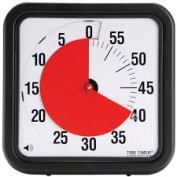
I have to say for those who need this kind of help, the timer I would recommend to try is the Time Timer

Back in the day, we used a kitchen timer.  You set it.  And it went off…loudly.  And then we did what was next on the schedule. Once your heart rate went back down to normal that is.  This time timer does not do that, it has a nice soft sound that signals time is up.  Which is both comforting and less anxiety producing than mine was.

Also, as opposed to the timer I used that had numbers only, this one has a red face that marks the time.  As the time ticks down, the red goes away.  So that our children know, if there is no red left, time is up.  

What a great visual schedule!   You can teach them to look at the clock for the numbers and how much red is left.

I always talk about teaching.  Because as parents and caregivers to these special needs children, you want to help them know and understand as much as they can about life and the world.  Taking the time to teach about schedules, taking the time to make the visual schedule (be it pictures or words) and taking the time to talk about the schedule after the day is done, will so help to reinforce concepts that prove hard to grasp.

This time timer will be a major sensory tool in their success to working with the concept of time.

Trust me, the time will become a very close friend of yours.  I am looking at the kitchen timer now and smiling because I can remember the words of Elizabeth “ Man, the timer went off, come on Michael, time to brush our teeth for school.”   

Yup, she may have not liked the time…but it worked.

I wish you all a good week.

Please let me know if you have any success stories you wish to share.

Michele


As I write this blog today, it is our typical Friday afternoon.  The great feeling that the weekend is upon us, the traditional pizza dinner (eaten in the den) and the chance to unwind from what was a busy school week for us all.  

Relaxation takes on many different forms depending on the person who is doing it.

Michael relaxes by bouncing a basketball and chatting away, about his day, Elizabeth on the other hand, relaxes by watching some television.  By herself.  Laying on the floor. Never on a chair, never on the couch.  It is what feels right to her.

We all have our own like and dislikes when it comes to listening to what our bodies and minds need through the course of each day.  And most of the time we can adjust from what we want to do to what we have to do, pretty much without missing a beat.

Example:  We may want to remove ourselves from a long, tedious lecture, but what we do is move to a new position to get comfortable, tell ourselves “only 15 more minutes”  and watch the clock.   (We may complain in our head about things or mumble a bit) but for the most part, we can manage to get through the lecture and our day.

But for those whose neurological system has trouble regulating itself…those times when we can manage by doing things like I mentioned, are the very times they cannot do it alone.  They need help to get their system to cope with and adjust to the environment around them.

Those on the Autism spectrum have sensory needs.  Those who have Sensory Processing Disorder have sensory needs.  Truth be told, we all have some sensory issues (I throw out the topic of itchy tags…anyone else guilty of ripping them out themselves?) but it is the degree to which they affect one’s day and life that makes the difference.  

There is something called a Sensory Diet, a phrase coined by OT Patricia Wilbarger.  It is a carefully designed, personalized activity plan that provides the sensory input a person needs to stay focused and organized throughout the day.

What this means is that certain sensory inputs are offered to the person in need throughout their day to help them.  Be it sounds, lights, texture and more.

Our brain receives sensory input from our five senses:  Seeing, Hearing, Smelling, Tasting, Tactile or Touch. These very senses, whose input can overwhelm a certain person’s system when they are too much,  can actually be used to calm another person who has different sensory needs.

And this is where the wonderful, unique and so amazing thing called a Sensory Diet comes into play.

Some people need less noise,  others need  to hear music or calming sounds, or even to block out sounds with something like earBanz to stay organized.

Some people need lighting that is calm, like when teachers use Fluorescent Light Filters to take away lighting that is too bright.

Some people shy away from being touched and others crave touch and pressure so weighted blankets can provide the input they are looking for.  As can weighted lap pads.

Fidget toys, such as chewy necklaces, chewelry or chewy tubes, can offer sensory input to those who need to move or fidget and even for those who have a sensory need to chew. 

So many things can be used to help a person who has sensory needs, it is all about finding the right item, in the right amount at the right time.  And this is where the OT or occupational therapist comes in.   

To get a sensory diet tailor made for your child will help beyond measure.  In my opinion, it is one of the most important things.  

The OT can help make this diet. And they can decide if your child needs brushing  which is officially called the Wilbarger method.  Please read about this wonderful protocol when you can.  But those brushes called Wilbarger brushes are the things that I feel helped Elizabeth the most in her earliest years.

A sensory diet is unlike any diet that one hears about on an infomercial.  It is not one that will trim a waistline or help with cholesterol.  For those who have sensory needs, it is downright life changing.    Please search our  website to see the amazing selection of sensory items, read how they are used and please ask questions to those who work with your child or please ask questions here on this blog site.  

I can share what we did, you can share your experiences and we can help those who just started learning about their child’s needs.

I wish you a peaceful week.