
Alison is a mid-thirties mum to two children, Little Man and Wee Girl. Wee Girl is pre-verbal and has autism, while Little Man is the sort of happy chatty little guy who gets into everything and sings at the top of his lungs — until the moment he makes eye contact with a stranger and he goes silent. Alison is cynical, sweary, and a bit disorganised, and she blogs about parenting, ASD, food and just about anything else she can think of. Read the original post here.

“We’re making lemon and lime muffins in this post, the recipe for which can be found here.
Wee Girl is fascinated by cooking. When I make scrambled eggs for lunch she insists on pushing the stool up to the side so that she can help stir. Same thing with making coffee, wiping down tables — all these things that she sees us doing every day and wants to be able to do herself.
This independence is fantastic and something which we want to encourage. One thing I try to do is bake with her. I don’t do it as often as I should, but we’re starting to get back into it now, and soon I’m going to be trying to cook more savoury recipes with her helping, such as pizza.
Because believe it or not there’s only so much cake a person can eat.
Cooking with your child can be brilliant for building speech and language because not only is it teaching them vital life skills (everyone needs to be able to bake, right?), it also involves following simple instructions. (“Can you tip this bowl of flour in there, please? Thank you!”) Cake can be an astonishingly effective motivator.
Part of what stops me from baking with Wee Girl is how complicated a lot of recipes are. Particularly cupcakes. Having to cream butter and sugar or beat the mixture isn’t doable because she doesn’t like the noise the mixer makes, and there’s no way I’m going to beat the mixture by hand.
Here are a some tips based on my experiences and what has so far worked for us.
 1.) Make muffins, not cupcakes. Muffins are perfect for cooking with kids. No beating needed; all you do is dump the wet ingredients into the dry, give them a cursory mix and start spooning them into the cases. There’s also no need to worry about the additional step of icing; when they’re done, they’re done.
2.) Don’t cook in the kitchen. Use a low table which helps your child to engage. I usually do this in the living room, which means carting all the ingredients and equipment from room to room. Yes, this is a pain in the backside, but a low table means that you can sit opposite your child, making it easier to communicate than it would be if you were both standing at a kitchen counter.
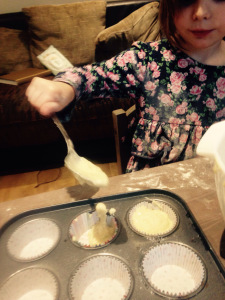 3. ) Pick a recipe that’s easy, without too many ingredients, but not too simplistic. This means thinking about your child’s attention span and how long they will engage for before they lose interest. Bear in mind that the fewer ingredients you use, the less you will have to cart from the kitchen to the living room. Having to nip back to get a few things means more likelihood of your child tipping half the bag of flour into the bowl while you’re away. Or smashing all the eggs on the floor.
4.) Read the recipe through and do any necessary prep. Try and do as much as you can at the table, bearing in mind your child’s attention span. Weighing and measuring, etc, is a fairly vital part of the recipe, so it would be a shame to do this hidden away in the kitchen.
 5.) Be prepared for your culinary creations to be… well, not necessarily something you’d like to eat. Think of it as a sensory activity for your child, rather than a culinary one. There will be double-dipping (which I couldn’t give a monkeys about, but I know not everyone feels the same way). There will he hands stuck into flour. There is a high likelihood of snot. Yes, in theory you’ve both washed your hands beforehand. But that doesn’t account for nosepicking afterwards, does it? So it’s fine if the thought of actually biting into those lovingly made muffins turns your stomach. They are for the kids, after all. And they make a wonderful treat for unwitting husbands: just don’t tell them about the snot.
6.) Make cleaning up part of the activity. Yes, there will be mess. Yes, it’s a pain in the backside. If you’re lucky you might get away with handing your child a cloth and leaving them to wipe the table, but we all know the soul-sapping bit is putting the ingredients away.
 7.) Be patient. Try again. Your child might not be all that interested at first. Maybe they’ll lose interest half way through or refuse to do anything to help. That’s okay. Try again. Try a few times. One thing I have learned with my own daughter is that just because she doesn’t look like she’s paying attention, it doesn’t mean that she’s not paying attention. And hey, even if it doesn’t work, who cares?
You have cake!
Enjoy.”
Special Needs Essentials extra tip: if you child has trouble grasping utensils, try this weighted soup spoon.
 Colorful, safe play mats offer many important benefits for
 ![play-Mat-3x3-foam-floor-tiles-special-needs-essentials [edited] (1)](https://blog.specialneedsessentials.com/wp-content/uploads/2015/10/play-mat-3x3-foam-floor-tiles-special-needs-essentials-edited-1.jpg)


 Special Needs Essentials Blog